
Index31 AUG 202611 min
AI-Native Is Not a Chatbot. It Is a Graph That Never Sleeps.
Buying seats for a chat assistant does not make a company AI-native. It takes loops that run around the clock, engineering graphs with humans only at the expensive gates, and a context layer defended the way a containment is. And it changes what the people are there for.
- AI systems
- Leadership
- Entrepreneurship
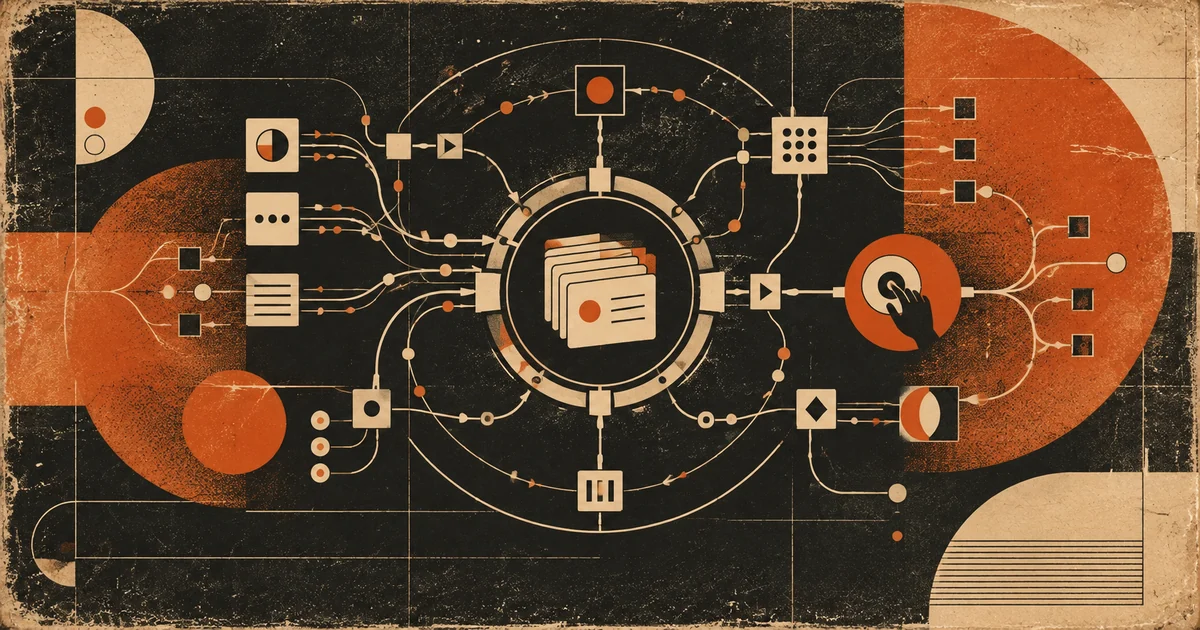
In 1999, Bill Gates wrote Business @ the Speed of Thought and described something he called a digital nervous system: every process and system in a company unified on one infrastructure, so that information reaches whoever needs it without being carried there by a person. His argument was that the 1980s had been about quality and the 1990s about re-engineering, and that what would separate companies next was velocity: how fast the business itself could be transacted.
What strikes me is not that he was early. It is that twenty-five years later the argument has not aged a day. Everything he described is still exactly the right target; he simply wrote it in an era where the nervous system could carry the signal but could not think about it. We can build the whole thing now. And the version we can build has one property his did not: it does not just route the signal, it acts on it.
That is what an AI-native company actually is. Not a subscription. A nervous system that never sleeps.
Almost every company I talk to has done two things instead: bought seats for a chat assistant, and told the engineers to code with a copilot. Then they wait for the transformation, and it does not arrive, because neither of those changes how the company works. They make individuals somewhat faster inside processes that are unchanged.
Here is what I would actually do, and what I would refuse to trade away.
Start with why, or nothing else lands
Before any tool, everyone has to understand why.
The answer is not "because AI is important." It is specific and measurable: the same unit of work costs less to produce, arrives sooner, and does not stop overnight.
I want to be careful about how I say the cost part, because it is easy to hear it as an insult and it is not one. A person doing genuinely excellent work still carries the overheads of being a person. The day has a fixed number of hours. Attention has to be rebuilt after every interruption. Every handoff between two people costs a conversation, a document or a meeting to keep both sides aligned, and some of what gets built has to be built twice because the spec was read two different ways. None of that is a failing. It is simply what collaboration between humans has always cost, and the best teams I have worked with, including my own, still pay every bit of it.
A loop does not pay those costs. It does not lose the thread while it was in another meeting, it does not need re-briefing on Monday, and it works the night and the weekend at the same rate as a Tuesday morning. Hand it a well-specified piece of work and the same output comes back for less, and it comes back while everyone is asleep. That is the argument. Not that people are slow, but that a system with no context-switching cost and no working hours is a genuinely different economic object.
That any of this is affordable to run at all is recent. Stanford HAI's AI Index put GPT-3.5-level inference at roughly 0.07 by October 2024, which is 280× cheaper in under two years. Work that was uneconomical to consider is now a line item.
If your team cannot repeat that reason back in one sentence, no amount of tooling saves the initiative. McKinsey's study of AI-native operators found 88% of organizations use AI somewhere, roughly 1% consider themselves mature, and about two-thirds never scaled past isolated pilots. The tools were never the bottleneck.
Loops that run 24/7, and graphs for everything you execute
Two pieces of architecture, and neither is a chatbot.
AI loops that run around the clock. A loop takes real-world signal (telemetry, tickets, billing events, code changes), runs it through a policy layer defining what the system may do without asking, calls tools, passes a quality gate, ships, and measures what happened. Then it goes around again. YC's Tom Blomfield frames the test cleanly: if the loop closes without a human in the middle, the product improves while everyone sleeps. If a human is the gate, the loop stops at 3am and waits.
Engineering graphs for every execution. This is the piece almost nobody has, and where quality is actually decided. A graph is a network with conditionals, agents holding distinct roles, each reaching context under different rules, and the human intervening only at specific gates. Orchestration, parallel work, adversarial verification, judging, synthesis. Not one model doing everything, but a topology that forces verification before commitment. I went through this in detail in The prompt was never the hard part. The graph is., and it applies to company operations, not only to product.
The gates are the real design problem. Too many and you have rebuilt middle management in software. Too few and the system commits things nobody sanctioned. Put a person where being wrong is expensive and irreversible, and nowhere else.
The context layer is the whole game, and so is its security
If I could only get one thing right, it would be this. A graph is only as good as the context its agents can reach, and a company's context is mostly not in its database. It is in conversations.
Capture. Record every meeting and transcribe it automatically. Every one, not the important ones, because you do not know which meeting mattered until you need it. Ask everyone to work in public channels: a decision made in a DM is a decision the company cannot learn from and a new hire cannot find. GitLab has run handbook-first and public-by-default for over a decade across 1,300+ people in 65 countries, long before there was a model to feed. Store it strictly, not casually.
For the audio side we built TranscribeGo precisely because this turned out to be the bottleneck. Meetings, calls, voice notes, anything recorded anywhere, including straight from WhatsApp, transcribed and kept. We use it ourselves. It exists because we needed the substrate before we could build anything on top of it.
Structure. The corpus feeds a company brain: one place where everything is indexed and reachable, where anyone asks in plain language, and where the loops go to read. And the brain does not only answer. It executes.
Defend. The moment you decide to record everything, you have built a system capable of surveillance. That is a plain description, not a warning shot. Whether it becomes an asset or a liability is settled entirely by the controls around it, and those controls have to exist before the corpus does. My background is nuclear engineering, and the discipline that transfers is that safety is architecture, not a feature added at the end, and it assumes the failure will happen.
Concretely: consent decided per jurisdiction and per room, because employees, candidates and patients are not the same case. Classification at ingestion: clinical, legal and compensation conversations cannot sit in the same undifferentiated pool as a standup, and you will never go back and sort it later. Retention with an actual clock. Residency and encryption you can point to. An audit trail, so you can answer who asked what and what came back.
And the control most teams get wrong: permissions enforced at retrieval, not on documents. If the brain reads across the whole corpus, it will happily synthesize an answer out of material the person asking could never open. Enforce access per user at the moment of retrieval, or you have built the most efficient leak in the company's history. Some of the data-layer choices behind this I covered in The database was the last thing we optimized for agents.
Design the gates so information flows up
Once the context layer exists, the question is who reaches what. Different parts of the company need different doors into the same brain, and the gates should be deliberate. But the direction that matters most is upward: whoever sets direction needs visibility into as much as possible, as fast as possible. Not dashboards. The ability to ask any question about the state of the company and get a grounded answer in seconds.
This is the part Bill Gates got exactly right and could not yet build. Velocity is not a nice property of the system. It is the whole point of having one.
The mindset is the harder half
Asking people to work in public channels, to record their meetings, to hand execution to a system, is not a tooling request. It is a request to change how they understand their own value, and some will hear "you are being replaced", which is the reasonable thing to hear if nobody tells them otherwise.
So change management is not a phase of this project; it is the project. Lead it with warmth, and budget more of your own time for it than feels reasonable. But that is a transition problem, and transitions end.
The thing that does not end is something else entirely.
The connection is part of the treatment
Here is what I actually believe about the human role, and it is not the usual answer.
The usual answer is that humans keep the hard judgment calls. I think that is a weak position, because it is temporary. We are going to be outmatched on judgment and on raw compute, not everywhere and not this quarter, but the direction is not seriously in doubt, and pretending otherwise makes you sound dishonest to your own team. If judgment is the whole case for keeping people, the case erodes every quarter.
The durable answer is that two things stay with people, and they are not the same kind of thing.
The first is the general strategy of the company, and the decisions that are critical to it. What we build and what we refuse to build. Which market, which bet. Which risk we are willing to carry, and which one would end us if we got it wrong. Where the line sits on something we are perfectly able to do and should not. A system can model those calls, and it can argue them well, and it should be asked to. But somebody has to own them, and ownership is not a computation. Execution goes to the machine. Direction stays with us.
The second is warmth, and it is the one that gets underrated because it sounds soft. It is not soft, and it is not a fallback for what the model cannot compute. Take medicine, and take it at the limit: imagine a clinic where every process runs through AI, and the diagnosis coming out of the machine is better than the one a physician would reach alone. Assume that. It is close enough to true in narrow domains already, and it is coming for the broad ones.
You still need a doctor.
Not to check the machine's work. To sit in front of the patient and explain what is happening to their body, with warmth, in a way that lands. To hold the pause when someone hears the word they were afraid of. To build enough trust that the person actually takes the medication, actually comes back for the follow-up, actually tells the truth about their symptoms next time. That connection is not the packaging around the treatment. It is part of the treatment, and it changes outcomes in ways that show up in the data.
The same structure holds in education. Assume the system builds a better curriculum than any teacher, adapts faster, never tires, knows exactly where a student is stuck. It still does not make a fourteen-year-old believe they are capable of something. A teacher does that, by being a person who visibly believes it first. And that belief is not decoration on the learning. It is the mechanism.
This generalizes. Wherever the outcome depends on a human being's trust, motivation, courage or willingness to be honest, a person has to be in the room, and not as a fallback for what the model cannot compute. As the part that does the work.
So the division is not "machines handle the easy things, humans handle the hard things." It is: machines handle everything that is a process, and humans handle everything that is a relationship. Execution, recall, routing, synthesis, drafting, monitoring. All of it goes to the system, and it will do it better. What stays is direction, and connection.
The labour market has already noticed. In the WEF's Future of Jobs Report, leadership and social influence is the fastest-rising skill in employer-rated importance since 2023, up 22 percentage points, the biggest jump in the survey, alongside AI itself. Employers building AI-native operations are not betting people become less human. They are betting hard on the opposite.
What I would actually do, in order
- Explain why. Efficiency, speed, cost: specific, measurable, repeatable by anyone on the team.
- Turn on capture: record everything, transcribe everything, public channels by default.
- Build the context layer and its controls in the same quarter. Never one without the other.
- Build graphs for your real executions, with humans only at the expensive gates.
- Close the loops so they run at 3am.
- Open the gates upward so decisions get faster.
- Move people off execution and onto direction, and onto the rooms where connection is the work.
- Lead the change with warmth, and give it more of your time than feels reasonable.
- Measure it. Instrument the loops rather than trusting that they feel faster.
None of this needs a model you have to train or a platform you have to buy. It needs decisions about how your company remembers, who can see what, and where a person has to be in the path.
Bill Gates saw the shape of this in 1999 and could only build the wiring. We can build the whole nervous system now. The question worth asking is not how much of the company it can run. It is which rooms we deliberately keep a person in, because in those rooms the person is the treatment.
Sources and further reading
- Bill Gates with Collins Hemingway, Business @ the Speed of Thought: Using a Digital Nervous System (1999)
- Federico Caccia, The prompt was never the hard part. The graph is., Rather Labs
- Federico Caccia, The database was the last thing we optimized for agents, Rather Labs
- Tom Blomfield (Y Combinator), Building and Structuring an AI Native Company, Startup School Paris. Transcribed with TranscribeGo
- McKinsey, The seven operating truths of AI-native companies
- Stanford HAI, AI Index Report 2025
- GitLab, Handbook-first communication
- World Economic Forum, Future of Jobs Report 2025

